
Is the purpose of a mosque only to pray
Category :
Islamic Thought & Analysis
Riyadul Hasan
"The mosque in Islam is not merely a spiritual center or a place of prayer; it is the administrative office of the Muslim society and state system. ... Currently, the mosque is used only as a prayer room; outside of prayer times, the mosque remains locked."
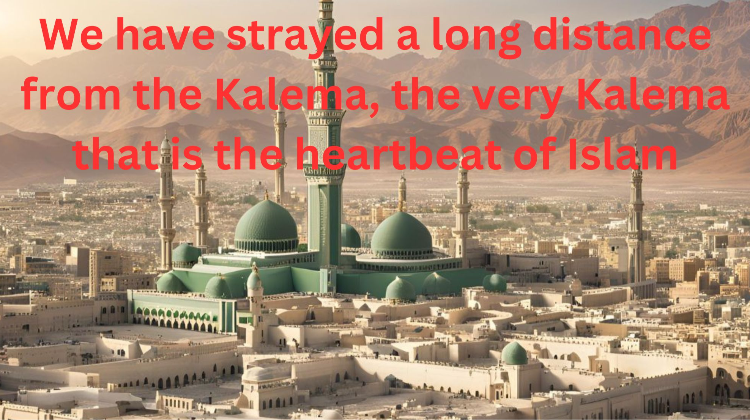
The Messenger of Allah (PBUH), on his way of Hijrah (migration), stayed in the village of Quba on the outskirts of Madinah for three or four days. The first thing he did here was build a mosque. Then, upon arriving in Madinah, before building a house for his own residence, he first built the Masjid-e-Nabawi. Since the early days of Islam, wherever Islam was established, Muslims would first build a mosque. What is the reason for this? Is it only for praying?
Mosque (Masjid) means the place of prostration (Sajdah). Prostration is not merely touching the head to the ground for Allah. The word Sajdah means to obey. The prostration in prayer is a practice of obeying Allah wholeheartedly. If touching the head to the ground were the only meaning of Sajdah, Allah would not have said that whatever is in the heavens and the earth prostrates to Allah, willingly or unwillingly (Surah Ar-Ra'd 13:15). Or 'the stars and the trees prostrate to Allah' (Surah Ar-Rahman 55:6, Surah An-Nahl 16:49). Because none of them touch their heads to the ground.
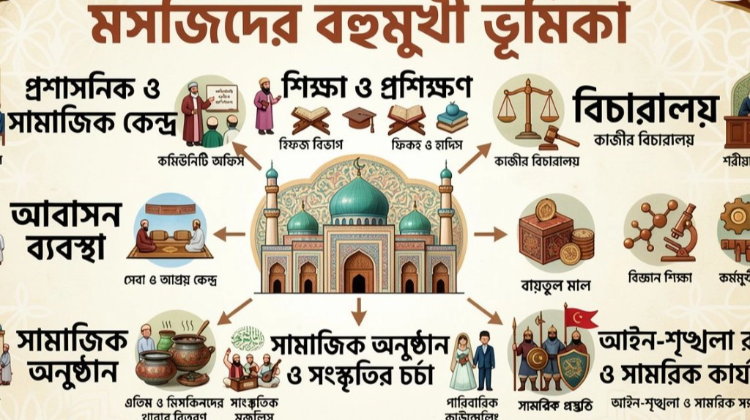
Islam is not like other religions. Just as there is a spiritual and character-building purpose behind every practice in Islam, there is also a worldly, life-oriented purpose. Therefore, the mosque in Islam is not merely a spiritual center or a place of prayer; it is the administrative office of the Muslim society and state system. That is why, upon migrating to Madinah, the Messenger of Allah (PBUH) first built a mosque. This mosque was the focal point of the social, political, military, and spiritual activities of Islam. Consequently, that mosque was bustling with activity. Currently, the mosque is used only as a prayer room; outside of prayer times, the mosque remains locked. In this way, by separating the mosque from social, educational, political, economic, and judicial activities for hundreds of years, the concept of the purpose of the mosque has been lost among the general public, and the mosque has lost all its activities, turning solely into a place of prayer. Let us discuss the true purpose and characteristics of the mosque.
Administrative and Social Center:
From the early days of Islam, mosques were used simultaneously as a social center and an administrative office for everyone in society. All Mu’mins (believers), irrespective of men and women, would attend the mosque for the five daily prayers. Any message to the nation was informed then. The teachings of the Deen (religion) and social rules and regulations also easily reached everyone. If there was any urgent matter, the Messenger of Allah (PBUH) would ask everyone to gather at the mosque at any time. The mosque-centric society of Islam allowed the ruler to stay close to the people. As a result, it was not possible for any kind of rumor to spread in the society. Especially through the Friday sermon (Khutbah), important messages were delivered to the nation by the Imam. Personal and social problems were solved by sitting in the mosque. Through discussion and consultation in the mosque, Muslims would easily resolve any crisis.
Economic Office:
The mosque of true Islam was a major medium for collecting the state-mandated taxes and charity funds. State taxes were collected and sent to the central Baitul Mal (state treasury). And when people gave Sadaqah (charity) or donations in the way of Allah, that money was distributed among the local poor and helpless. The Imams of the mosques were not only the leaders of the prayer but also the leaders of the society. They served as executive officers of the state. Their salaries and allowances, as well as those of the Khatibs, were paid by the state. As a result, the Imams, Khatibs, and related staff of the mosques did not depend on public donations. They did not have to sit on the streets with donation boxes in the name of building a mosque.
Courthouse:
To bring the judicial system to the doorsteps of the people, the Jame Masjid (central mosque) was also used as a trial and arbitration center. Here, social disputes were settled through arbitration without any financial cost. Judges conducted judicial proceedings, heard cases, gave verdicts, and executed verdicts throughout the week in designated areas of the mosque complex. Since everyone gathered at the mosque on Fridays, some exemplary punishments were carried out in public on that day. The judicial process in Islam was transparent. This increased people's faith in justice. However, complex and serious matters were referred to higher courts. Most complaints were settled at the local level. During the Caliphate of Abu Bakr (R.A.), the Chief Justice was Hazrat Umar (R.A.). In one year, practically not a single criminal case came to him. One of the main reasons for this was that most of the complaints were resolved in the local mosques. As Allah's Deen was established, injustice and crime in the society had also dropped to almost zero. Yet currently, about 4,652,000 cases are pending in the high and lower courts of Bangladesh (The Daily Star - July 5, 2025). If that mosque-based judicial structure could be implemented again today, it would be possible to get rid of this backlog of cases.
Education and Training Center:
Salat (prayer) is the primary character training given by Allah to the Ummah of Muhammad. It provides the nation with training in unity, discipline, obedience, punctuality, teamwork, patience, self-control, focus, and spirituality. Besides the five daily prayers, the mosque of the Messenger of Allah (PBUH) was a center for education and training for all men and women of the nation. In the era following the Messenger of Allah, knowledgeable scholars of the Deen would sit in the mosque and teach people about various spiritual and worldly matters. From the mosque, free education on the Quran, necessary knowledge of Hadith, daily Islamic rulings (Masala-Masayel), state discipline, fundamental beliefs (Aqidah) of the Deen, and Islamic culture was provided. However, in Islamic civilization, outside the mosque, there were also separate schools, universities, and specialized educational institutions called Madrasas. It wasn't just the pursuit of knowledge; during the time of the Messenger of Allah (PBUH), physical activities like exercise, sports, running competitions, wrestling, archery, and spear throwing were also conducted in the mosque courtyard. The Messenger of Allah (PBUH) would enjoy these games with his family and sometimes even participate in them. Through this, not only was entertainment achieved, but the youth of the nation also became dynamic, vibrant, hardworking, and always ready to struggle against injustice.
Accommodation System:
During the golden era of Islamic civilization, state guest houses were built around the mosque. Administrative officers and staff lived there. The Messenger of Allah (PBUH) himself lived close to the mosque, and a group of dedicated companions lived within the mosque itself; they were called Ashab-e-Suffa (People of the Veranda). Accommodation for representatives arriving from various tribes or states was also arranged in the mosque. During the era of the subsequent Caliphs and Sultans, each mosque complex was built over a vast area. For example, the Great Mosque of Samarra in Iraq, built by the Abbasid Caliph Al-Mutawakkil (854 CE), had an area of 200,000 square meters. Inns were established near the mosque courtyard, where pedestrians, travelers, and destitute people found food and shelter. These inns (Community Canteens) were primarily run by funds and goods obtained from donations, Sadaqah, agricultural Ushr (tithe), etc., from well-off local families. The glamorous hotel businesses like today were not seen in Islamic civilization, where people do not recognize each other without money. Nobody gives two morsels of rice to someone even if they are starving. To change such an inhumane society, there is no alternative to establishing the way of life given by Allah.
Participation of Women:
The opportunity for women's participation in the mosque, the House of Allah, was wide open. They could go to the mosque at any time of the day or night to seek solutions to any crisis, along with performing acts of worship. There was no one back then to issue a fatwa like today's: "Women's entry is strictly prohibited to maintain the sanctity of the mosque." They participated just like men in all prayers, sermons, judicial proceedings, and social events like weddings, Aqiqah, and discussion meetings. There was no gender discrimination in that society. In the early days of Islam, such a large number of women frequented the mosque that a separate door had to be built for them during the time of Caliph Umar (R.A.). In that golden age, there was no separate seating arrangement for women; men and women prayed in the same congregation (Jamaat) and listened to discussions sitting together. No one can show any history of a black cloth curtain being hung between them.
Law and Order Maintenance and Military Activities:
The law and order and military departments of a nation are extremely important. During the era of the Messenger of Allah (PBUH) and his companions, the center for conducting military activities was the mosque. The place at the front of the mosque indicating the Qibla is called the 'Mihrab', which literally means the stage of battle. Because at that time, worshippers would stand in prayer leaving their swords there. And after the prayer, they would take them from there. The mosque and its courtyard were also used as a place for military discipline, obedience, and basic physical training for the combat-capable members of the nation.
Social Events and Cultural Practices:
During the era of true Islam, various social and religious events, including weddings, were completed in the mosque. The Messenger of Allah (PBUH) gave instructions to conduct these ceremonies in the mosque. The mosque was one of the centers for practicing Islamic culture. Instead of the degenerate culture of the Age of Ignorance (Jahiliyyah), mosque-centric activities played a massive role in practicing a healthy culture.
In today's reality, if we can once again establish Allah's Deen in society and the state, then it is possible to turn the hundreds of thousands of mosques in the country into the focal point of these multifaceted activities. Then the mosque will no longer be limited to just a place of prayer; rather, it will become vibrant as an effective institution for administration, education, justice, social resolution, and human welfare. The doors of the mosque will remain open twenty-four hours a day—no lock will hang there anymore. As a result, on the one hand, the additional infrastructural expenses of the state will decrease, and on the other hand, people will benefit by receiving necessary services right near their homes. Consequently, a welfare-oriented society will be built on the basis of discipline, justice, and mutual empathy in society.
Images Related to this Post










Leave a Comment