
Connection Between Islamic Philosophy and Cultural Practice
The philosophical foundation of Islam is that, at the beginning of human creation, there was a challenge between Allah and Iblis. Iblis is a being who pushes humans toward wrongdoing, while Allah guides them toward truth and justice. Iblis challenged Allah that he would tempt humans into division, chaos, injustice, oppression, conflict, killing, and bloodshed. In response, Allah would send prophets and guides throughout time to protect humanity from these evils. Those who follow divine guidance will be free from injustice and conflict and will attain Paradise in the Hereafter. One of Iblis’s tools for spreading disorder in society is obscenity.
Therefore, songs, dramas, and films are not inherently forbidden if they are free from obscenity, injustice, and meaningless content. Rather, if they convey meaningful messages—humanity, unity, truth, and inspiration toward establishing justice—they are commendable. In early Arabia, people sang while playing the duff, and the Prophet Muhammad (peace be upon him) himself listened to songs.
A hadith is often cited against music: once, while passing by, the Prophet heard the sound of a flute and covered his ears until he passed it. Later, he asked his companion Nafi whether he could still hear it. When Nafi said no, he uncovered his ears (reported in Ibn Majah and Abu Dawud). However, the Prophet did not punish the flute player or prohibit music outright. Perhaps he personally disliked that particular sound. Just as people today have different tastes in music, this does not make all music forbidden.
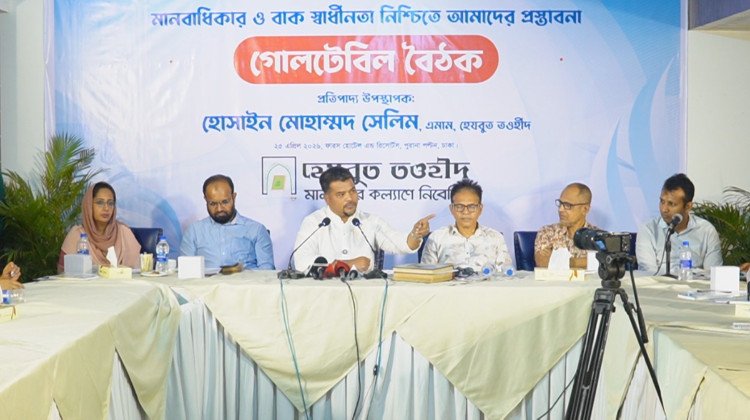
Regarding the proposed state system of Hezbut Tawheed, a question arises whether cinemas would exist. The response is that currently, cinemas are nearly nonexistent or of poor quality. The aim is to create a refined cultural environment with high-quality cinemas so people do not need to spend money abroad to enjoy good films or concerts. While Hollywood produces advanced films showcasing national strength (though sometimes promoting obscenity), local cinema remains limited and of low quality. The goal is to revive a lost cultural heritage.
During the medieval Islamic period (600–1700 CE), culture and education flourished across Africa, the Middle East, Persia, Central Asia, and the Indian subcontinent. The philosopher Al-Farabi wrote the famous work Kitab al-Musiqa al-Kabir (The Great Book of Music), still influential today. Dynasties such as the Umayyads, Abbasids, Seljuks, Ottomans, and Mughals supported arts, literature, and education.
Music and literature thrived, particularly during the Mughal era. Cultural exchange between Hindus and Muslims led to new musical forms. The great musician Tansen, one of Emperor Akbar’s court members, developed famous ragas. Sufi saints like Khwaja Moinuddin Chishti and Nizamuddin Auliya used musical gatherings (sama and qawwali) to promote spirituality, divine love, and human unity.
Some claim that ghazals are permissible but music is not. However, historically, the word “ghazal” meant romantic dialogue. Later, Sufi poets transformed it into a medium of expressing divine love.
Muslim civilization also contributed significantly to musical instruments such as the oud, qanun, rabab, nafir, and tambourine. These influenced modern European instruments like the guitar and trumpet.
In rural Bengal, farmers sing traditional songs like bhatiyali and bhawaiya while working, which energizes them and relieves fatigue. Music is part of human nature and brings peace and comfort.
Prophet Dawud (David) was given a beautiful voice that even mountains and birds joined in praising Allah. The melodic call to prayer (adhan) also demonstrates the beauty of sound. Imam Al-Ghazali stated that melodious sounds are not inherently forbidden. However, music that promotes vulgarity, chaos, or harms the soul is prohibited.
A cultural regulatory body (censor board) is considered necessary to ensure that artistic works do not promote obscenity, hatred, or moral corruption. If such elements are absent, the state should support cultural production.
The Prophet himself exercised such judgment. In one narration, young girls were singing at a wedding. When one made an incorrect statement about the Prophet knowing the unseen, he corrected that part but did not stop the singing.
The aim is not to restrict creativity but to ensure it remains free from obscenity and polytheism. Cultural expression—including music, film, literature, and art—is encouraged within ethical boundaries.
Respect for cultural diversity is emphasized. Different religious and ethnic communities have their own traditions, and these should be respected. However, if any cultural practice spreads hatred, conflict, or moral harm, it should be addressed through lawful means.
In Bangladesh, Islamic cultural influence is deeply rooted. From birth, children hear the call to prayer and are given meaningful Islamic names. At the same time, Bengali cultural traditions such as Pohela Boishakh, with fairs, food, and communal harmony, are shared across religions.
Islamic celebrations like Shab-e-Barat, Shab-e-Qadr, and Eid are also part of cultural identity. However, debates have emerged, with some opposing these traditions or calling others un-Islamic. This mindset needs to change.
Islam does not support harassment based on appearance or beliefs. It promotes tolerance and balanced living. It neither supports moral extremes nor cultural suppression.
Western societies may accept certain forms of artistic expression, such as nude sculptures, but these may not align with local cultural values. Cultural sensitivity and respect are essential.
Traditionally, modesty has been a defining feature of local culture. However, today there are extremes—either excessive exposure influenced by Western trends or excessive restriction in the name of religion. Islam advocates a balanced approach.
Currently, Western cultural influence dominates globally, and Muslim youth often follow foreign media due to the lack of strong cultural production within Muslim societies. This decline is attributed to neglect of arts and culture.
Historically, Muslim writers produced rich literature reflecting moral and spiritual values. Bengali Muslim poets like Kazi Nazrul Islam, Farrukh Ahmad, Jasimuddin, and Golam Mostofa made significant contributions. Today, such quality is lacking.
The root cause is the rejection of cultural engagement and the rise of rigid interpretations that discouraged artistic expression. As a result, society now depends heavily on foreign culture.
It is time to rethink our understanding of Islam. Not everything declared forbidden by certain groups is truly forbidden. The true standard is the Qur’an and the authentic teachings of the Prophet. Hezbut Tawheed aims to revive this understanding and initiate a cultural and intellectual renaissance based on authentic Islamic principles.
Images Related to this Post






Leave a Comment