
The Forces Behind Anti-India Politics in Bangladesh
-Mukleshur Rahman Suman
Broadly speaking, Bangladesh’s politics can be divided into two regimes or blocs. One is anti-Pakistan (or Pakistan-opposing), and the other is anti-India (or India-opposing). Those who engage in anti-Pakistan politics are often labeled as “pro-India,” while those who are anti-India are labeled as “pro-Pakistan.”
In any case, this India- and Pakistan-centered labeling is an established reality in Bangladeshi politics. Before elections, statements like “this party is a Pakistani agent” or “that party will sell the country to India” are commonly heard. These narratives also influence voters.
Now, this tendency to center political discourse around two foreign countries has several historical reasons. The issue with Pakistan is clear—rooted in the events before and during the Liberation War. On the other hand, anti-India sentiment has older roots. Since the British colonial period, hostility was deliberately fostered between Hindus and Muslims in the subcontinent. Over time, that anti-Hindu sentiment evolved into anti-India sentiment.
However, I believe the main reason for dragging these two countries into domestic political narratives is the ideological vacuum within our political parties. When they fail themselves, they resort to focusing on others.
Take the example of the Awami League. They have governed independent Bangladesh for the longest period and thus had the greatest opportunity to prove themselves as the right leadership for the country. But have they truly succeeded in doing so?
The same question applies to the Bangladesh Nationalist Party. As for Bangladesh Jamaat-e-Islami, it has not had the opportunity to govern, which indicates an even greater failure to gain public trust.
Returning to anti-India politics—if a political party were ideologically strong, if people had confidence in it, and if it were seen as capable of governing Bangladesh, then there would be no need for cheap political narratives or discussions centered on foreign countries.
The biggest question is: given Bangladesh’s geographical and geopolitical reality, what benefit is there in anti-India rhetoric? Can we completely sever ties with our neighboring country? If that were possible, the recent interim government would have withdrawn from agreements made with India by previous governments. But they did not cancel even a single agreement.
In fact, before the last election, the leader (Ameer) of Bangladesh Jamaat-e-Islami said in an interview with an Indian media outlet: “If we come to power, improving relations with India will be a priority.” When even the head of the most anti-India party says this, it shows that maintaining good relations with the neighboring country is essential.
Readers should not think from my writing that I am emotionally inclined toward India or fearful of it—I am neither. However, in recent years, the way anti-India sentiment has been incited in Bangladesh, and the way some voices across the border have also expressed anti-Bangladesh rhetoric, is not comforting. For any country, a hostile “cat-and-mouse” relationship with its neighbor is not sustainable.
Such hostility might only make sense if we were aligned with a powerful global state and gaining major advantages as its proxy in the region. But Bangladesh has not surrendered itself to any global power.
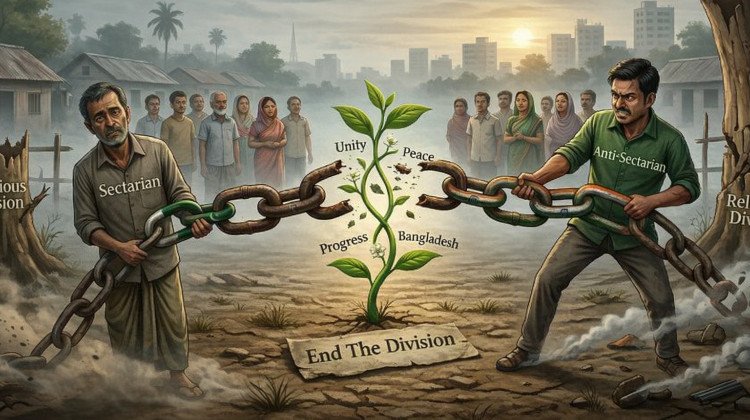
I believe we should move away from anti-India politics and instead focus on strengthening ourselves. In our country, when one party comes to power, it suppresses the other. When the other returns, it retaliates and drives the former out. This cycle of division and revenge will not take us far.
The real question is: how do we end this cycle of hostility? How do we overcome our ideological emptiness? We must search for answers to these questions. We must find a basis for unity and reject division.
Images Related to this Post












Leave a Comment