
Is Islam only about worship or a complete guide to life
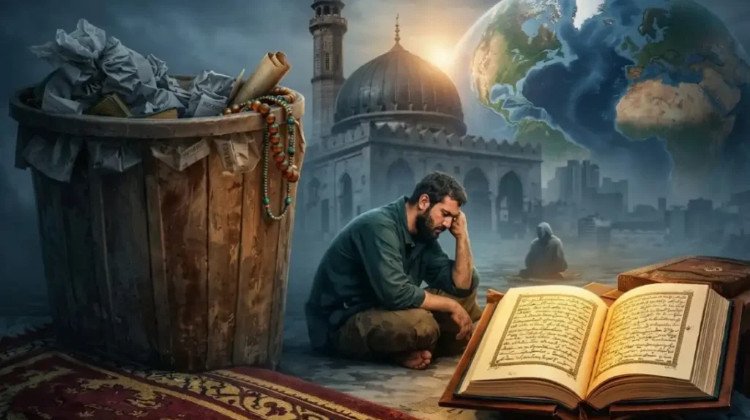
The true value of anything depends on whether it fulfills its purpose. For example, the purpose of a phone is communication. If a phone cannot be used to talk, then no matter how expensive it is, it becomes worthless as a phone. One might show it off, but to actually communicate, they would need another functional phone, even if it is cheap. Do we keep purposeless things in our homes? No—we eventually throw useless things away. So tell me, can there be any command in the system of life given by Allah that has no purpose? Common sense says no.
Now, if we do not understand the true purpose of Allah’s commands—or misunderstand them—then our actions become like carrying around that expensive but useless phone. Regarding such purposeless deeds, Allah says:
“I will turn to whatever deeds they did and make them into scattered dust.” (Surah Al-Furqan 23)
The unfortunate reality today is that many Islamic practices have become like that expensive phone—meaningless—because their true purposes have been lost, and they are performed with incorrect intentions. Even the purpose of Islam itself is misunderstood. If we ask: What is the main objective of Islam? Why were the Prophets sent? Why was a nation formed? What is the purpose of the Qur’an?—we will get different answers.
Yes, Muslims agree on the fundamentals. They pray, fast, and perform Hajj. But they are often unclear about why they do these acts. Common answers include: “Because Allah commanded it,” “to gain Allah’s pleasure,” or “to earn rewards.”
If your father asked you to go to the market, you would first ask what to bring. Without knowing, your effort would be wasted. Similarly, we must follow Allah’s commands—but with understanding. Otherwise, our actions become pointless. That is why the Prophet said that actions are judged by intentions. Allah also says:
“Do not pursue that of which you have no knowledge…” (Surah Bani Isra’il 36)
What is the purpose of Islam?
It is a grave mistake to think of Islam as merely a spiritual or moral religion like others. Islam is a complete system of life. It provides guidance not only for personal spirituality but also for society and the state—covering economics, justice, politics, administration, culture, education, family, business, and even international relations.
A person cannot truly be a Muslim only in private life. Islam must be practiced in all aspects of life. The purpose of this system is to eliminate injustice and establish peace and justice. That is why it is called “Islam,” meaning peace.
What is the purpose of the declaration of faith (Kalima Tawheed)?
When non-believers accepted Islam, the Prophet would have them recite the Kalima: La ilaha illallah. He said whoever says this will enter Paradise. But how is that logical?
This declaration is a contract between a person and Allah: “I accept no authority except Allah.” If someone truly accepts Allah as the sole lawgiver, then Allah’s laws must govern their life.
For example, if Allah has forbidden interest (riba), but a state allows it, a true Muslim cannot accept that system. Similarly, if courts do not implement Allah’s laws, accepting them contradicts the declaration of faith.
Thus, this simple statement transforms one’s entire life. It is not just words—it is the foundation of a system and a declaration against man-made systems. It makes striving to establish Allah’s system obligatory.
What is the purpose of the Qur’an?
We have Qur’ans in every home. Many memorize it, recite it beautifully, and complete it during Ramadan. It is often believed that its purpose is simply recitation.
But is that why it was revealed? No. Allah says in Surah Al-Baqarah that it is a guidance for the God-conscious. It is meant to guide life.
The Qur’an is the constitution of Allah’s system. If a constitution is not implemented, it has no real value. Allah repeatedly states that He sent His Messenger with truth so that it prevails over all systems.
If we only recite the Qur’an but do not apply it, its purpose is lost. For example, Allah declared war against interest, yet interest dominates our societies. What benefit is there in recitation without application?
What is the purpose of Salah (prayer)?
Prayer is widely seen as the main form of worship. People say they pray because it is obligatory, to gain reward, or to seek peace.
But these are not the primary purpose. The Prophet said Islam is like a house: faith is the foundation, prayer is the pillar, and striving (jihad) is the roof. The pillar supports the roof.
Thus, the purpose of prayer is to prepare believers for striving in Allah’s cause by building discipline, unity, obedience, and strength.
Like a trained army, believers develop discipline, punctuality, unity, and obedience through prayer. The structure of Salah resembles coordinated drills, training both body and mind.
It builds qualities such as cleanliness, focus, brotherhood, patience, and commitment. It also strengthens spiritual readiness for sacrifice.
Without this purpose, prayer becomes meaningless.
Conclusion
Every aspect of Islam has a purpose. When actions are performed with understanding, they become meaningful. All Islamic practices have real-world purposes—to establish peace and order in this life.
While there are rewards in the hereafter, the primary purpose of Islamic teachings is to create a just and peaceful life in this world.
Images Related to this Post




Leave a Comment